Universal Morality
Prior to about 1960 or so the dominant scientific view of human nature was the Behaviorist school of thought. Basically, the idea was that the human mind/brain is created as a 'blank slate' upon which experience writes. The properties we develop as adult individuals and even as a species can be explained by examining the input we receive as we mature. It is difficult to understand what a hold this view had on the field of psychology, owing in no small part to how nicely it fit in with the dominant psychological therapy at the time, Freudian psychotherapy.
The Behaviorist view of things, however, was strongly shaken and ultimately shattered in the late 50s and through the 60s by the work of an unknown linguist named Noam Chomsky (though the remnants remain - I recall reading in my 10th grade psychology class that humans have no instincts). Chomsky claimed that at least some properties that the human species shares were not learned, but genetically innate. He claimed that, with regard to language, he could prove it, showing that language is a subconscious system that is learned subconsciously and therefore cannot plausibly be said to be taught or learned in the behaviorist sense of those terms. Since that time, and due in large part to advances in genetics technology, we've come to learn that many things about us - both particular and species-wide - are genetically determined, though it sometimes unsettles us.
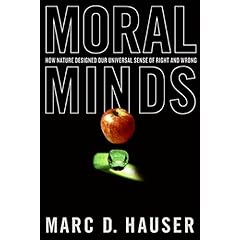
But what about our values, our morals? Surely if there is one thing not encoded in our genes, its our judgements of right and wrong, right? But a new book by Marc Hauser, famed expert on the human and animal mind, claims that this isn't the case. Humans, he claims, have evolved over time a 'moral faculty' of sorts. Making moral judgements, he claims, is a part of being human and the ability to do so is encoded in our genetic make-up. Now, do not misunderstand, Hauser isn't claiming that we make any particular moral judgement because of our genes. If that were the case, there would be no way to explain why people disagree on moral matters. Rather, he is taking a page from Chomsky (a friend and collaborator) and claiming that humans are born pre-programmed with a set of universal principles which, together with input from our environment (including our parents, pastors, etc) gives us the ability to construct a system which we employ for moral judging. Just as we are born with a univeral set of principles that gives us the ability to acquire English or Japanese or whatever language we are exposed to, Hauser is claiming we are born with a universal set of principles that gives us the ability to acquire whatever moral system we are exposed to.
The claim is interesting and begs obvious questions, the most important of which is what boundaries these principles place upon the construction of moral systems. One also wonders when these systems are constructed. Is it as children? In that case, do we lose the ability to acquire moral judgements as adults as we do language? Does that explain why it may be much more difficult to alter our views on morality as adults than it is as children? That is what we would expect, anyway, if the parallels to language learning are to be taken seriously.
posted by Lame and Blind @ 1:04 PM
0 comments


0 Comments:
Post a Comment
<< Home